Official feasts used to be an important part of the human community. People would gather together to remember something sacred, express their faith and hope for the future, and / or just be together formally, recognizing each other as being part of a shared community. Few things express a desire for shared companionship and social intimacy more than dining together. Sadly, the gathering together for feasting is increasingly a relic of the past – at least here in the West.
It need not be so! Today we will remember the ancient feasts.
THE FEAST DAY OF ST. Brigid
This feast is a Christian religious celebration of St. Brigid of Kildare, a 5th Century abbess who founded the important abbey of Kildare (Cill Dara), as well as several other convents of nuns. She is one of one of Ireland's three national saints, along with Patrick and Columba.
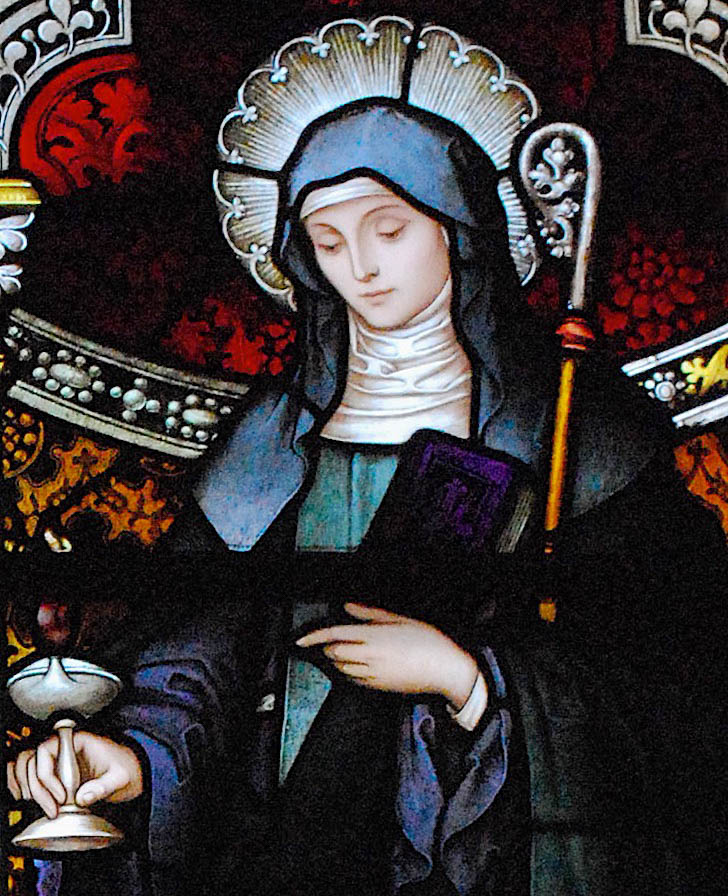
Saint Brigid of Ireland in stained glass at St. Joseph Catholic Church in Macon, Georgia, United States
Who is St. Brigid?
Saint Brigid of Kildare or Saint Brigid of Ireland (Irish: Naomh Bríd; Classical Gaelic: Brighid; Latin: Brigida; c. 451 – 525) is the patroness saint (or 'mother saint') of Ireland, and one of its three national saints along with Patrick and Columba. According to medieval Irish hagiographies, she was an abbess who founded the important abbey of Kildare (Cill Dara), as well as several other convents of nuns. There are few historical facts about her, and her hagiographies are mainly anecdotes and miracle tales, some of which are rooted in pagan folklore. They say Brigid was the daughter of a chieftain and a slave woman, and was raised in a druid's household before becoming a consecrated virgin. She is patroness of many things, including poetry, learning, healing, protection, blacksmithing, livestock and dairy production. In her honour, a perpetual fire was kept burning at Kildare for centuries.
Some historians suggest that Brigid is a Christianisation of the Celtic goddess, Bríd. St Brigid's feast day is 1 February, and traditionally it involves weaving Brigid's crosses and many other folk customs. It was originally a pre-Christian festival called Imbolc, marking the beginning of spring. From 2023 it is a public holiday in the Republic of Ireland. This feast day is shared by Dar Lugdach, who tradition says was her student, close companion, and successor. The occasion is marked on the first Monday on or after 1st February.
Name
The saint has the same name as the goddess Brigid, derived from the Proto-Celtic *Brigantī "high, exalted" and ultimately originating with Proto-Indo-European *bʰerǵʰ-. In Old Irish her name was spelled Brigit and pronounced [ˈbʲrʲiɣʲidʲ]. In Modern Irish she is also called Bríd. In Welsh she is called Ffraid (sometimes mutated to Fraid), such as in several places called Llansanffraid, "St. Brigit's church". She is also referred to as "the Mary of the Gael" and the "Mother Saint of Ireland".
Historicity
There is debate over whether Brigid was a real person. There are few historical facts about her, and early hagiographies "are mainly anecdotes and miracle stories, some of which are deeply rooted in Irish pagan folklore". She has the same name and many of the same attributes as the Celtic goddess Brigid, and there are many supernatural events and folk customs associated with her. Like the saint, the goddess in Irish myth is associated with poetry, healing, protection, smithcraft, and domestic animals, according to Sanas Cormaic and Lebor Gabála Érenn. Furthermore, the saint's feast day falls on the Gaelic traditional festival of Imbolc. Some scholars suggest that the saint is a Christianisation of the goddess; others that she was a real person whose mythos took on the goddess's attributes. Medieval art historian Pamela Berger argues that Christian monks "took the ancient figure of the mother goddess and grafted her name and functions onto her Christian counterpart". Dáithí Ó hÓgáin and others suggest that the saint had been chief druid at the temple of the goddess Brigid, was responsible for converting it into a Christian monastery, and that after her death, the name and characteristics of the goddess became attached to the saint.
Life
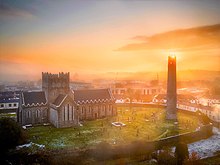
Kildare Cathedral, built on the site of the original abbey said to have been founded by Brigid
Sources
Among the most ancient accounts of St Brigid are two Old Irish hymns; the first by St Ultan of Ardbraccan (died c. 657), Brigit Bé Bithmaith ('Brigid ever-excellent woman') also known as "Ultan's hymn", and the second is "Broccán's hymn", composed by St Broccán Clóen (died c. 650) at the request of Ultan who was his tutor. Two early Lives of St Brigid in Hiberno-Latin prose, the Vita Sanctae Brigitae I and II, were written in the 7th–8th centuries, the first one possibly by St Aleran (died in 665), lector of Clonard, the second by Cogitosus, a monk of Kildare. An Old Irish prose Life, Bethu Brigte, was composed in the 9th century. Several later Latin and Irish Lives of the saint were composed. The Vita III, in hexameter verse, is sometimes attributed to St Coelan of Inishcaltra of the 7th–8th centuries, but appears more likely to have been written by St Donatus, an Irish monk who became Bishop of Fiesole in 824. In Donatus' prologue, it refers to the earlier Lives by St Ultan (see before for his hymn), St. Aleran (see "Vita I") and an Anonymus. A 34-hexameter Latin poem about St Brigid had previously been composed by the Irish Roman cleric Colman c. 800.
Discussion on dates for the annals and the accuracy of dates relating to St Brigid continues.
A short video on the saint, below, makes a compelling case that the saint truly existed.

How is St. Brigid's Feast Day celebrated?
via irishpost.com
Ireland has celebrated Saint Brigid's Day with a number of firmly-held traditions-- despite Brigid living close to 1500 years ago, many of these traditions are still observed today.
The most famous of these traditions are the making of the Saint Brigid's Cross, a unique cross made from fresh rushes or reeds which children are taught how to make in school.
Traditionally, before Saint Brigid's Day these crosses are made in schools, communities and private home across Ireland, before they are brought to the church on 1 February to be blessed.
The crosses are then hung in people's homes, where they are believed to bring good luck and prevent fire and hunger of those inside. The crosses hang for a year, until new Saint Brigid's Crosses are created the next year-- the old ones are then burned in the fire.
On the eve of Saint Brigid's Day, households across Ireland leave some clothing outside of their homes in the hope that it will be blessed by Saint Brigid.
These items of clothing can include a cloak or shawl of some sort to reflect Brigid's miracle with the cloak in Kildare. It is said that the clothes which are left outside on Saint Brigid's Eve would then be imbued with healing powers, and should be wrapped around a sick or injured person or animal.
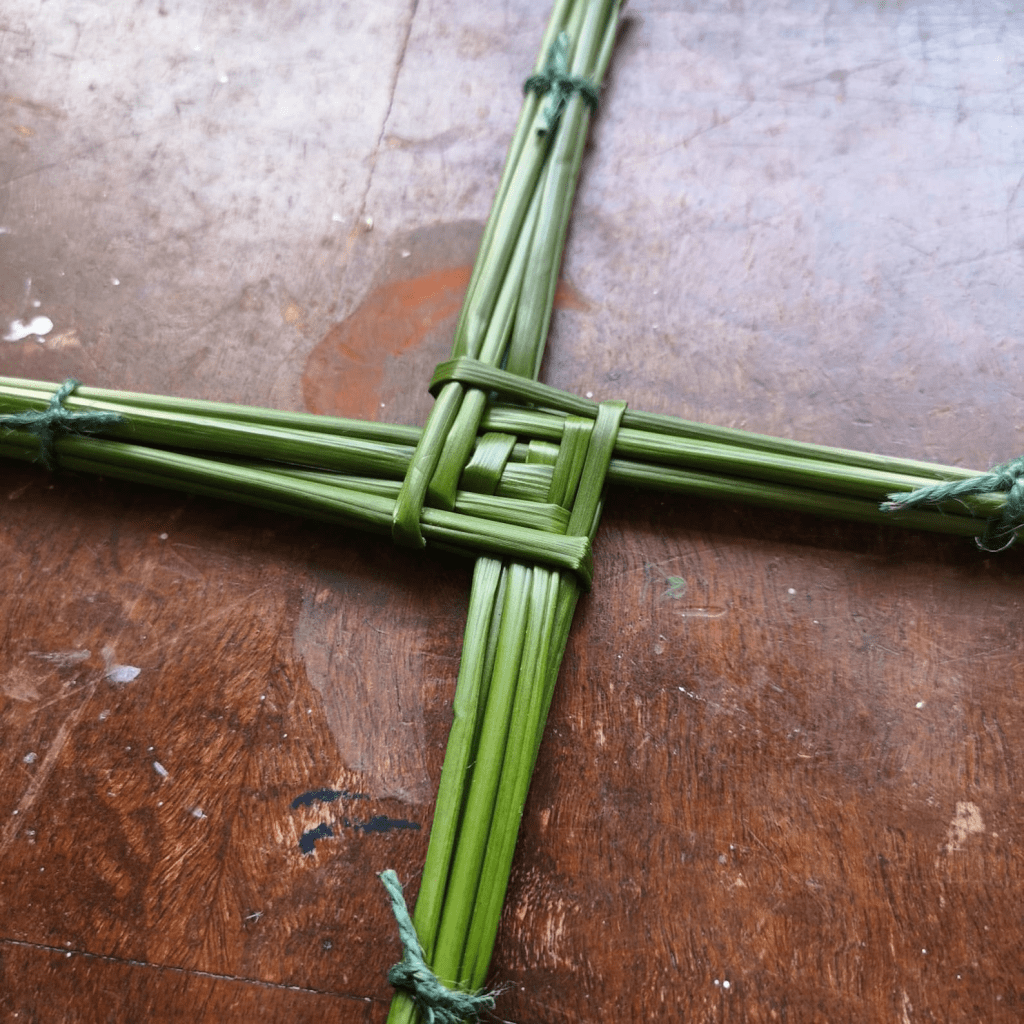
Example of a St. Brigid Cross
What Do you eat for St. Brigid's Feast Day?
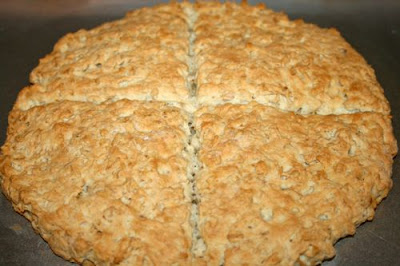
One traditional food served on St. Brigid's Feast Day is called St. Brigid's Bread.
Recipe via setonmagazine.com
Ingredients
- 1 cup flour
- 1 tbsp. sugar
- 3/4 tsp. baking powder
- 1/4 tsp. baking soda
- 1/4 tsp. salt
- 3 tbsp. butter, in small pieces
- 3/4 cup uncooked oatmeal (old fashioned)
- 1 egg
- 1/2 cup buttermilk
Directions
- Preheat your oven to 425º degrees Fahrenheit.
- Grease a baking sheet.
- Mix flour, sugar, baking powder, baking soda, and salt in a bowl. Add butter bits and cut in with a knife until mixture is crumbly. Add oats and mix well.
- Beat the egg with the buttermilk in a separate bowl.
- Make a "well" in the dry ingredients, then pour in the egg mixture and mix all with a fork until the crumbs hold together. Form the dough into a ball and knead (on a floured surface, about 20-25 times). Add flour if the mass is still too sticky to work with.
- Form the dough ball into an 8-inch round and transfer it to the baking sheet.
- Score a deep cross into the bread but do not cut through.
- Bake for fifteen to twenty minutes, or until medium brown and a tester comes out clean.
(Follow the link above if you want to see the recipe for making your own butter, too.)
Are there traditional prayers that one says for St. Brigid's Feast Day?
There are, as you might expect, many. I have included one below. (via IrishCentral.com)
A prayer to St. Brigid
You were a woman of peace.
You brought harmony where there was conflict.
You brought light to the darkness.
You brought hope to the downcast.
May the mantle of your peace
cover those who are troubled and anxious,
and may peace be firmly rooted in our hearts and in our world.
Inspire us to act justly and to reverence all God has made.
Brigid you were a voice for the wounded and the weary.
Strengthen what is weak within us.
Calm us into a quietness that heals and listens.
May we grow each day into greater
wholeness in mind, body and spirit.
Amen.
The prayer is often said as a daily devotion, or it can be recited during times of need, such as when seeking guidance or protection. Many people find comfort in the prayer's simple, straightforward language and its focus on the gifts of the Holy Spirit.
St. Brigid's Prayer is also a popular devotion for those who are of Irish descent or who have a connection to Ireland. For many people, the prayer is a way to honor the rich history and culture of Ireland and to pay tribute to St. Brigid, who remains a beloved and revered figure in Irish history and spirituality.
Whether you are of Irish descent or simply looking for a simple and beautiful prayer, St. Brigid's Prayer is a powerful and uplifting devotion that is sure to bring comfort and peace to your heart and soul.
When is the Feast Day of St. Brigid celebrated?
The Feast Day is celebrated on 1 February.
Beannachtai Lá Féile Bríde!
(St. Brigid's Day blessings to you)





No comments:
Post a Comment