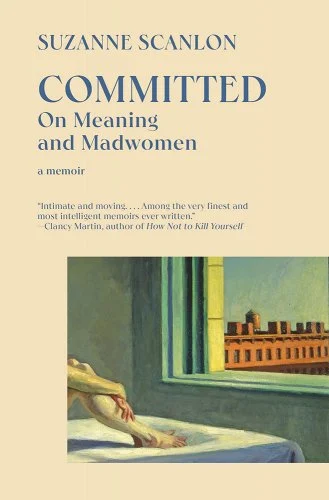
Suzanne Scanlon's Committed: On Meaning and Madwomen excavates some of her most formative memories for clues to her evolving selfhood. The death of her mother when Scanlon was nine years old, her relationship to literature, particularly the writings of Marguerite Duras, and her years spent institutionalized are linchpins in this layered examination of sanity and care.
In 1992, as a lonely undergraduate who could not seem to find a foothold in the bustling Big Apple, twenty year-old Suzanne Scanlon gradually made a suicide pact with her only local friend, Leo. At the critical moment, when he called saying he had enough pills for the both of them, that he would come get her, asking if she was ready… she said not yet. "Maybe tomorrow," she offered. But he couldn't wait anymore. The next day, certain that her friend was already dead, Scanlon's experience of the world simply reinforced one of the last things he had said to her: "Nothing's going to change." The things that plagued her now would surely do so forever. So she made her own attempt—to catch up to him. This is what ultimately brought her to the New York State Psychiatric Institute, which would become her home for nearly three years.
Grief, language, and the self are three of several major themes that Scanlon skillfully weaves through the text until their inextricability becomes unmissable. Losing her mother at such a young age meant that Scanlon did not have the language to process her loss. Nor the time, considering how soon afterward her father, struggling to remain afloat in this new version of family life, remarried. Scanlon's number of siblings suddenly multiplied from three to five with the addition of two step-siblings, then six as her father and stepmother began having children together. Though these details of her life are foundational to her self-concept and eventual status as a long-term inpatient, Scanlon is both careful and adamant in illustrating just how many other factors combine to create the selves we become attached to for better and for worse. She writes candidly of using her grief, her diagnoses, her experiences of certain literature, her daily habits, anything and everything, to form a self that is both recognizable to her and fit for consumption by others.
Committed highlights the lack of language to properly describe our emotions and needs as a significant barrier to "going sane" as one of Scanlon's doctors put it. At one point she recounts the mounting usage of the phrase "I feel empty" among the patients on her ward, herself included, and how that admittedly "vague" descriptor became something like a life ring in their shared quest to describe their inner states. She also recalls that, at the time, emptiness could be found in the DSM as a symptom of borderline personality disorder and that many on her ward were subsequently diagnosed with it. Both patient and doctor are revealed to be seeking definitive language, the word or words that will pin a person and their problems down and expose the route to repair; an endpoint from which to begin again. The myth of the "fixed self," a final or core iteration, is the engine driving the institution as well as Scanlon's identification with sickness.
During her time there, Scanlon determines her failure to establish a stable self who can survive daily life to be symptomatic of her illness. Eventually, though, she comes to learn of different ways not only to exist but to recognize and consider mental illness, its varied causes, and ways of manifesting including as a performance of incommunicable need. The doctors and patients form a symbiotic connection, with one expressing—through self-harm, antisocial behaviors, disordered eating, etc.—a need to be cared for, and the other a need to be legitimized, seen as knowledgeable and necessary. Scanlon also takes some time to dwell on the reality that not everyone has the ability to obtain or even seek the care she received, and that every person in need deserves, in a section that addresses external factors of mental illness that don't apply to her, like race-based systemic oppression. Here, she cites Toni Morrison's Beloved, Ntozake Shange's for colored girls who have considered suicide/when the rainbow is enuf, Gloria Naylor's Linden Hills, and more extensively, Tsitsi Dangarembga's Nervous Conditions as examples of texts that for her shed light on alternative circumstances for madness.
Literature emerges rather quickly in this nonlinear account of Scanlon's past as her saving grace, a thing that continually provides her with the language needed to articulate who she has been and who she once hoped, and hopes still, to become. Marguerite Duras's The Lover imparted the language for life-altering desire; the Charlotte Perkins Gilman story "The Yellow Wallpaper," language regarding the performance of the need for care; Julia Kristen's Black Sun provided language for the inexpressibility of her grief; Audre Lorde's The Cancer Journals gave her language for her mother's illness as well as her own indignation as a daughter abruptly deprived of her mother. Virginia Woolf. Adrienne Rich. Shulamith Firestone. Sylvia Plath. Janet Frame. Sinéad O'Connor. Scanlon identifies the ways in which these women artists and others have shaped her shifting sense of self and her growing conviction that a "fixed" self is unreachable, insightfully drawing the reader's attention to the many selves she has discovered within her favorite books and art throughout her life.
Among the most important inclusions in this memoir is Scanlon's account of the aftermath. Her attempts at reintegrating into the "real world." The numerous calls to her doctors from the outside. Unloading her woes through the phone because it affirmed her to have at least one witness. The return visits to the hospital for emotional top-ups, reassurances that someone wanted her to be well, reminders of the place where she felt alternately trapped and safe. In sharing post-patient life—hers, fellow patients', friends'—Scanlon lets us know that there is no finish line. That "fixed self"—as in both immovably stable and completely repaired—can never be yours. But maybe you'll find different ways to live, different selves to be that offer more comfort than anxiety.
This review can only ever be a vain attempt to enumerate all that is relatable and insightful within the covers of Scanlon's Committed. Though it appears to follow the author's winding stream of consciousness, the catalog of her thoughts is not disorganized. Every return to a particular subject is purposeful and revelatory. It is one of those books many will likely say they could have used earlier in life, but that will no doubt also be said to have come right on time because anytime is the right one for this book.
NONFICTION
Committed: On Meaning and Madwomen
By Suzanne Scanlon
Vintage
Published April 16, 2024




No comments:
Post a Comment