The Chicago Review of Books is proud to partner with The Chills at Will Podcast to share new audio interviews with today's brightest literary stars, including Jonathan Escoffery, Morgan Talty, Deesha Philyaw, Luis Alberto Urrea, and more. Hosted by Peter Riehl, The Chills at Will Podcast is a celebration of the visceral beauty of literature and the passages that thrills us as readers.
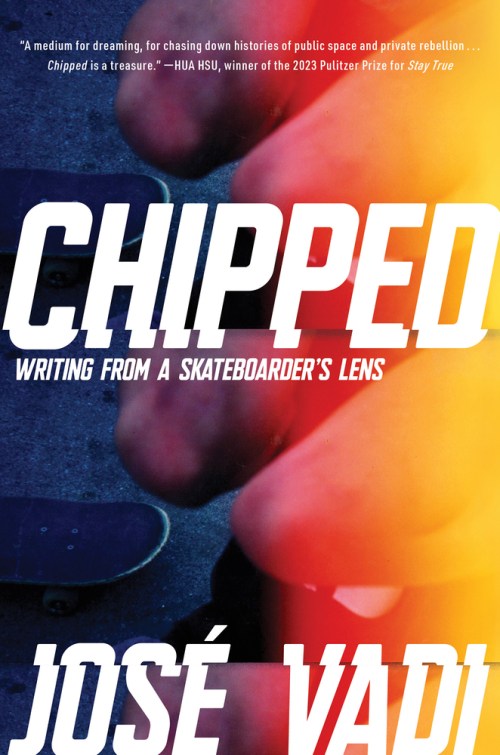
José Vadi's essay collection shines in its quiet power; his writing and description builds to an impressive crescendo, or oftentimes, builds to a crescendo before settling down to a profound but never facile revelation.
Chipped is made up of ten essays that shine in their individuality and as a whole alchemize into a bird's eye view of the art of skateboarding and its place in a creative life and in a contemporary society that doesn't always value the contemplative life.
I spoke with José about being an observer and active participant in skating's evolution and the ways that larger societal changes have been mirrored and adapted to skating's ethos. Our conversation touched upon skating and its athletic bonafides, music's impact on skating and skaters, and vice versa, aging, documentation, and the pure joy of the pursuit.
*This interview has been edited for length and clarity and was taken from a live recording on April 13, 2024, at the book launch for Chipped, held at Capital Books in Sacramento, CA.
Pete Riehl:
This comes from somebody whose only skating experience was (shout out to my neighbor, who put me on his board) when I was four. I fell, I hated it. That was it.
You artfully made the book accessible; it has its jargon, but it's also universal. This is to say that it's very specific to skating, yet quite accessible to non-skaters. What makes the collection so great is that you give us enough background information, and then when you don't, the reader thinks, I want to know more. You pull us in. How did you manage to make it widely accessible, yet specific to the skater cultures/subcultures?
José Vadi:
That was part of the challenge for sure. I wondered, Could I pull it off? My wife Meghann is kind of the first line of editorial defense. Since she's not a skater, the question is, "Can you understand this? Does this make sense? Does this make sense even if you don't know what a heelflip looks like or doesn't look like? Can you understand the physicality of what I'm trying to describe in this scene, regardless of your knowledge of the trick?"
If [his work] kind of passed the test, then I knew I was moving in the right direction, but I also embraced those moments where I didn't want to explain anything, and I wanted the reader to work and just embrace whatever I was giving them, like there has to be this kind of larger thing and they need to buy into the larger point of the essay.
I think in either example, like giving people information or not, it was like, how is this working for the specific essay or the specific chapter within this larger book, like, what point is either method trying to prove?
Pete Riehl:
Tell me about the importance of Ed Templeton (a professional skateboarder, contemporary artist, and photographer) in your writing and skating lives.
José Vadi:
In the book, I write about an art column that he used to have in a skate magazine.
And, I worshiped [the column]. I met him when I was a kid multiple times and was [in awe], like "Oh my God, you're my favorite skater. Sign this piece of crap I have in my wallet." (Laughs)
He was the first skater/artist who gave me the agency to do both at the same time and see the art and creativity of skateboarding and documenting everyone that you're with in showing those slow moments as some of the most important moments.
He was a photographer and I would go to all of his art shows that I could in LA; I kind of followed him, and it was first through his column [that I became familiar with him].
It gave me the green light to write: here's this dude that's saying that you're not only a skater if you're feeling these things: it's not only just because you're skating and you're outside and being impacted by this thing, but because skateboarding gives you the agency to do whatever you want-to be an artist, to be as creative as you want.
Pete Riehl:
I was thinking about aging, as there's a lot about that throughout the book, and you quote Ed Templeton, "Documentation is domination."
I'm thinking of the different skateboards and the flags and the stickers and all that.
Can you talk a little bit about owning your board and ideas of "documentation?" It seems to be akin to somebody having a car 15 years too long, but they can't bear to get rid of it.
José Vadi:
That's a very good example and a very Californian example too, similar to skateboarding. That kind of corporal relationship you have with a board and seeing the progress you're making, learning tricks on your board itself, is very interesting.
It becomes this kind of extension of you in a sense, even if you go through a board every session, like a tall human might. I keep all my decks and a lot of them, especially as a kid, were given to me by friends. Some of [these friends] are no longer on this earth, so the boards become these heirlooms that you keep, and they also reflect the era of skateboarding in which you were doing whatever you were trying.
Certain stickers reflect certain companies that are no longer around or certain skate shops that boom and bust over the course of two years, so it's like these little time capsules and when you start acquiring products or start trading with kids or making VHS mix tapes of skate videos, maybe 20 or 30 minutes long.
So in a six hour tape, you can make a whole canonical representation, like the Mount Rushmore of skate videos; it becomes very tactile, very quick. In addition to your body slamming against the pavement constantly, it also becomes this relationship with the toy, your shoes, and all these things-a new relationship with them.
I love the idea of this empathy-I love the board for the board-like how basketball players sleep with their ball, as Kobe Bryant used to do.
You hear these legendary stories. like "I used to carry it all the way to school," and when I see that, I understand the obsession.
Pete Riehl:
A lot of people on social media have been posting about the raggedy basketball that was used outside that everyone played with on the playground. Raggedy, but it provides for great memories. The ball is still very much yours.
José Vadi:
Hanif Abdurraqib has this new book that just came out [There's Always This Year: On Basketball and Ascension] that everyone should buy, all about basketball. He talks about the local that shows up to your court with the super worn-out ball.
You need to be worried about those dudes the most in a pickup game because they're so dedicated that they're ready to ball with whatever good or bad equipment they have.
It's like when you see kids at a skatepark with super-destroyed boards, but they're trying harder than someone with a pristine new board.
Pete Riehl:
You understand the obsession, and also that relationship with I don't want to give this up. As basketball players back in the day, we would clown on the guy who came with the newest shoes and the nicest gear-is that the same thing in the skateboarding community? I know it's a great community, but I wonder if there's a feeling of, "Come on, man, you're trying too hard. You've got the newest, the nicest, no crease in your shorts."
José Vadi:
It's a lovely shit-talking community. It's the same as when you go to a punk show and you see someone with the perfectly stitched, all brand-new denim jacket with all the patches, and you're like, This was assembled.
Pete Riehl:
You have a powerful essay in the collection, "Wild in the Streets." It's 4th of July 2007, 2007. You're gonna hit up a concert that night. You're gonna skate during the day. Describe the energy of that day and night in the Bay Area..
José Vadi:
It was a critical mass thing where all these skaters from the Ferry Building [in San Francisco] skated down Third Street all the way to the skate spot called "Third and Army." That was a pretty crazy time. All these skaters were just taking over the streets. It was sanctioned by the cops, so there was a police escort of all these skateboarders, which was very lovely.
At night, I went to this metal show that my roommate was more into, being more aware of the scene than I was. I went with him and it was like the four shades of metal in a sense.
It was speed metal and then Weedeater [a North Carolina-based band], which is a little more sludgy and then, Earth and Sunn O [both Washington state-based bands], which is like one begot the other.
It was really loud, and it was like I hopped from subculture to subculture, all within San Francisco. Here's the city that can host this kind of all these different parties at once.
And a lot of the after parties from the skate event, I would learn the next day were pretty violent, like some firecrackers went off and a drummer lost their thumb, like all this [chaos].
But the whole essay is about this kind of competition in the city that day, where you can kind of feel this energy across town, whether it was skaters taking over all this part of town or this metal show, or Dolores Park being a de facto fireworks expo.
There was a lot going on at the time, and [in the essay] I was just trying to capture the energy and being young and going between Oakland and San Francisco, San Francisco to Oakland and running to catch the last bus home.
Thinking, Let's not get stuck on the 800 bus through West Oakland and all these different little locales.
I was trying to illuminate, to show this one-night-in-town, what-can-happen-in-the-city, kind of vibe.
Pete Riehl:
This is like Bob Seger's "Night Moves," plus [the movie] Dazed and Confused.
The action is just so cool. The quote from the essay is "Everyone was part of the San Francisco story that day."
And like so many of the essays in the collection, it's action, action, action, action.
Then at the end, the reader says to herself, Whoa, the ending really puts all into perspective.
Youth Speaks is the organization you were with in college-open mic, slam poetry type of stuff. There's a scene in the collection where you were supposed to kind of hide out and like, you're amongst the students and having them be unsuspecting, and then you get into the performance.
That's what happens with so much of your writing where for the reader, it's "Oh man, there's an incredible point here."
You don't hammer the point home, though, so the reader is kind of unsuspecting.
Tell us about Youth Speaks and its lasting impact on you-I mean, you were on stage with Saul Williams and some big time names.
José Vadi:
Youth Speaks does after school programming. I was a 19 year old in the program; we would do school assemblies where we would pop up, like at different points in the building.
We would give each other the last lines and go in an order that was predetermined, and then kind of guerilla poetry and like, wow, the kids and like get them into writing kind of thing. That was a big part of my undergrad.
That was like my job in undergrad-doing that for K through 12 schools, and getting kids into writing.
It was amazing, and still is an amazing, nonprofit that kind of begat a lot of different creative people, like the Blindspotting [an award-winning 2018 film] people-Rafael Casal, Daveed Diggs of Hamilton. They came out of that program. Chinaka Hodge was a writer for [HBO Max's] Snowpiercer, which I think Daveed was on as well, and Chinaka came out of that program, too.
There are a lot of people that got into Hollywood writing and screenwriting [through Youth Speaks]; it was this gateway drug into being a poet and then a playwright, [writing] short films-it really ran the gamut. It was almost like going to like the Fame school [a 1980 film].
The program had that energy, but it led to leading a sort of dual life-like, I'm a student in college, going to Berkeley, studying history and not writing, and then I'm doing all this other writing stuff on the side directly in the communities of the Bay Area. Sometimes I'd ditch a lecture to go do a gig, that kind of stuff.
These were the kind of trenches where we learned how to write. You'd get a [note] like, "Tomorrow night you're going to do this opening for this artist, at this club. Can you write a poem for this amount of minutes, for this amount of money, in 24 hours?"
"Yeah, yeah, sure, sure, I got this."
It was really that kind of boot camp of freelance.
Pete Riehl:
Are there any shows or movies that have gotten it right with skateboarding, or close to right?
José Vadi:
MTV Sports did a pretty good job in the 90s, and the Tony Hawk documentary Until the Wheels Fall Off was really interesting. I think it was even [revelatory] for skaters.
It was a trip hearing Lance Mountain say, "Yeah, I will die for skateboarding."
You're like, Whoa.
It kind of introduced the concept of CTE within skateboarding as well. I think Until the Wheels Fall Off is really interesting.
And, of course, Epicly Later'd. It's produced through Vice, but it's really this one man show with Patrick O'Dell, who used to be a staff photographer for Thrasher. It's probably the best nonfiction representation of skateboarding.
Pete Riehl:
Any books that have gotten it right, present company excluded?
José Vadi:
Well, Iain Borden from the UK wrote Skateboarding and the City, which is pretty much the history book of skateboarding. I would call it like the best close-to-history book about skateboarding, cited in [my book] a lot. Kyle Beachy wrote The Most Fun Thing a couple years ago, and that heavily inspired this book as well.There's a non-skateboarding book: Molly Schiot has a book called Game Changers: The Unsung Heroines of Sports History. It's a coffee table-style book, but it's one photo and a short description of nothing but female athletes, and it's absolutely amazing. It inspired Inter State; it's a really good sports book that inspired a lot of this [book].
This interview is excerpted from Episode 231 of the Chills at Will Podcast. Listen to the complete conversation here.
NONFICTION
Chipped: Writing From a Skateboarder's Lens
By José Vadi
Soft Skull
Published April 16, 2024







No comments:
Post a Comment